The Island Off Stony Point
By Regis Schilken
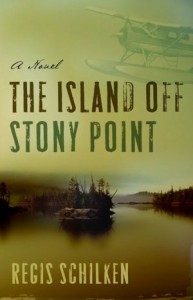 The Island Off Stony Point : Keith Sinteris and his wife Malena (the brains of the operation) hire three skilled accomplices (Stony, Bartolo and Duane) to kidnap three hostages from a monastery along with the holy tabernacle containing consecrated “bread”. For all her planning, Malena had no way of knowing just how awry the hostage taking could go.
Detective Jessica Harding and FBI Agent Rob Dexter are on the case. Strong willed and quick witted, Jessica puts the FBI agent in his place from the moment the two were introduced. Intrigued, Rob cannot get her out of his mind. With so few clues, the odds are stacked against the two “good guys”, yet they struggle on while the immense ransom demands continue to haunt the Catholic Church.
This is a well-told story line involving a mysterious home on an island that has a distinctive secret. The author uses scenes such as the fantastic cave hideout, the lung-busting chore of stashing loot and a magnificent storm to heighten interest.
There are several unique aspects to this suspense-filled novel over others in the adventure crime thriller genre. For one thing, the two women are the strongest characters – both leaders and quick thinkers, but on opposite sides. The Island off Stony Point certainly conveys the inherent goodness of people but also shows the great lengths that desperate and driven people will pursue. I also thought it was interesting that this is actually the second novel involving the leading hostage character, a Father Martin – who was in Regis’s first novel, The Oculi Incident.
Kudos to author Regis Schilken for this excellent novel! Read More Reviews Here…

The Bottomless Well
By Peter Huber And Mark P. Mills
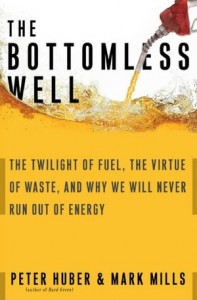 The Bottomless Well: The Twilight of Fuel, the Virtue of Waste, and Why We Will Never Run Out of Energy : For anyone who has any interest in energy, its cost, future and the political debate over this precious resource- The Bottomless Well is a must read. This book is an intriguing insight to the other side of what most of us have been led to believe on the environmentalist monopoly of the subject. The Bottomless Well makes the case that most of the things we think we know are mostly myths- because we really don’t understand what the essence of energy is in the first place. The book demonstrates how a better understanding of energy will radically change our views and policies on a number of very controversial issues. The Bottomless Well also explains why demand for energy will only continue to increase, why most of what we believe is “energy waste” actually proves out to be a benefit for all; why more efficient vehicles, engines, and light bulbs will never lower demand, and why the earth’s energy supply is actually infinite.
The Bottomless Well goes on to point out that that the cost of energy has increasingly less and less to do with the actual cost of fuel. With roughly five percent of the world’s population, America consumes over 25 percent of the world’s natural gas, 43 percent of its motor gasoline, 25 percent of its crude petroleum, 23 percent of its coal, and 26 percent of its total electricity production. But the book points out that most our energy consumption isn’t for locomotion, lighting, or cooling. What we use energy for, mainly, is to extract, refine, process, and purify energy into ever higher states of efficiency. The more efficient our technology, the more energy we actually consume; not save, because the cost to reward ratio is so positive for the consumers of this highly refined energy. The book also point out that the competitive advantage in manufacturing will soon be shifting decisively back toward the U.S.: the human demand for energy will only continue to grow and is indeed insatiable; raw fuels sources are not running out; and America’s relentless pursuit of high-grade energy does not add chaos to the global environment but rather restores it to order. Indeed, expanding energy supplies mean higher productivity, more jobs, and a growing GDP. Across the board- energy isn’t the problem, energy is the solution.
While the conventional wisdom holds that energy consumption is the problem and certainly some would disagree from an environmental impact concerning (at lest fossil fuel) energy consumption, The Bottomless Well argues that from an environmental perspective it also makes sense to use energy in an ever more efficient state. For example America, unlike most of the poor developing countries, is a net carbon sink. That is, despite all the pollution produced in America, there is more CO2 PPM upwind of America on the Pacific side then there is downstream of it over the Atlantic. This fact is undisputed, but although the book does offer some anecdotal reasons why this might be the case there is no definitive evidence to explain this unexpected phenomenon.
I would strongly recommend The Bottomless Well to anyone, no matter where they might stand on the issues of energy, the environment or politics. The book breaks the mold on many of our conventional views of energy, how we use it and why. At very least The Bottomless Well opens the door to another school of thought, not to mention a healthy debate about energy policy and our future. Read More Reviews Here…
YOU The Smart Patient
By Dr. Michael F. Roizen
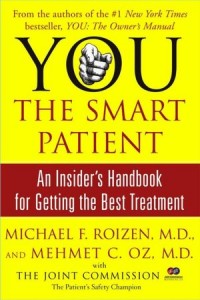 YOU: The Smart Patient: An Insider’s Handbook for Getting the Best Treatment. Take it from those in the know-two of America’s best-known doctors and the Joint Commission, watchdog for quality and safety of health care in America-there are steps you can take to make sure you get the very best medical treatment possible.
Dr. Michael F. Roizen is a practicing anesthesiologist at the Cleveland Clinic and founder of RealAge.com. Dr. Mehmet C. Oz is a practicing cardiothoracic surgeon at New York Presbyterian/Columbia Medical Center.
Together, these doctors have joined with Joint Commission Resources to create “You: The Smart Patient: An Insider’s Handbook for Getting the Best Treatment,” a new book that shows how every patient can take charge of his or her own health care and get the best treatment available.
The book gives readers clear, definitive information on such topics as creating a health profile, choosing the right doctors and hospitals, avoiding medication errors, preventing infections, understanding prescription drugs, working with doctors to safely use alternative treatments, and helping a loved one by being his or her health care advocate.
Here are a few useful tips from the book:
• Stick to the facts. Patients often give doctors too little pertinent information and many distracting off-topic details. The first sign of a smart patient is a health profile. To create a health profile, find the sample form in the book labeled “Your Health Journal” or fill one out online at www.jcrinc.com and www.RealAge.com.
• Have a tattle plan. Bring your spouse to the doctor’s appointment. There are questions he or she may be able to answer that you can’t.
• Find Dr. Right. One of the most important decisions you will ever make is choosing your doctor. To find a great doctor, ask the ER nurse-manager at the best local hospital. A nurse in the intensive care unit is also a good choice. These registered nurses get a battlefield view of doctors at their best and worst.
• Go board-certified. The American Board of Medical Specialties recognizes 24 areas of medical specialty including anesthesiology, cardiology, internal medicine and pediatrics. You can search for board-certified physicians at www.abms.org or call (866) 275-2267.
• Case your hospital. To find the best hospital for you-whether it’s a small community hospital, a hospital in your rural area or a large teaching hospital-go for an accredited hospital listed on the Joint Commission’s Web site at www.jointcommission.org. Joint Commission accreditation is the Gold Seal of Approval for a hospital-and that’s what you want. The Joint Commission also evaluates ambulatory clinics, home health agencies, home medical equipment companies, nursing homes, laboratories and behavioral health care facilities.
• Know your hospital’s numbers. Research has shown that for several common operations, hospitals that perform a specific number or more of that operation every year have better success rates. Your surgeon should be able to give you this info, as should the hospital’s information line.
• Make a new “phriend.” Your pharmacist is the least expensive and most accessible health resource you have. Smart patients develop a personal relationship with a pharmacist, which makes it easier to ask questions.
• Insist on being scanned. In the hospital, have staff check your hospital ID bracelet before they give you any medication, take blood or wheel you off for a test. If your hospital uses a bar-code scanner on ID bracelets, insist they scan you every time.
• Do you know how fast your ER treats heart cases? What is their average time for getting heart attack patients into surgery? Hospitals are required to document their times. Read More Reviews Here…
Fabulous After 50
By Judy Steinberg And Raechel Donahue
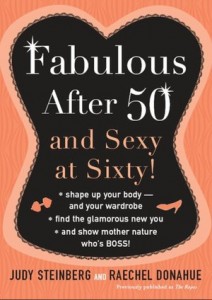 Fabulous After Fifty: And Sexy at Sixty! For women in this day and age, hitting 50 doesn’t automatically call for breaking out the knitting needles. Today’s mature woman has the verve and style of a much younger person, yet she emanates the power and wisdom that can only come with those extra years.
While life may not exactly begin at 50, it doesn’t have to lose speed either. Women wanting to keep their lives glamorous, confident, sexy and successful can find a bonanza of experience and advice in “Fabulous After 50: And Sexy at 60!”.
Co-author Judy Steinberg, an attractive, vibrant woman who is often mistaken for someone decades younger, was utterly shocked when she first experienced age discrimination. At that moment, she vowed to share her frank and funny insights with older women everywhere.
With great panache, Steinberg offers tips and tricks on everything from diets and exercise to interpreting what a man is really saying and the importance of female friendships.
Whether one is suddenly single or simply looking for some sisterly advice, Steinberg navigates the course by addressing issues specific to women who are old enough to remember “Sex and the Single Girl.”
The book is a salute to a new generation of vital, successful and gorgeous older women. Read More Reviews Here…
Fictoids
 Fictoids: Short Fiction…Very Short While truth may be stranger than fiction, a fictoid is definitely funnier than a factoid, says the author of an hysterical new book.
What exactly is a fictoid? A fictoid is a bit of fictional history making a statement or telling a story in one sentence.
“A typical fictoid tells who did what, when and where,” says Bill Dutcher, author of “Fictoids: Short Fiction…Very Short” . Neither historically accurate nor politically correct, the book takes a random walk through cultural history from 1220 B.C. to 2004.
Readers can learn who invented self-storage and who invented both the periodic table and the occasional chair; why Henry the Ninth couldn’t get a date; who founded General Eclectic; who recorded “You were always there for me…but I was always here”; who told his bankers “You can call my loan, but it won’t come”; who opened a high-priced helium bar, believed to be New York’s first Squeak Easy; and whose unauthorized autobiography sold more than one million copies.
The book introduces such colorful characters as Sleeping Beauty’s sister Lazy Susan, Norwegian film star Harrison Fjord, classical rap artist Yo Yo Mama and assistant press secretary Feckless Spinmeister. The illustrations were done by The New Yorker magazine cartoonist Jack Ziegler. Read More Reviews Here…
The Tales Of Wooffer’s Woods
By Betty Fasig
 The Tales Of Wooffer’s Woods : Wooffer is a collection of thirty-three short animal-adventure children stories originally written by Betty Fasig for her family. The center character is Wooffer, a hairy dachshund puppy that “mom”, the author, receives as a surprise Xmas gift from her fun-loving family.
A host of animals grace the pages of Wooffer, including Old Agnes the mouse, thoughtful and protective Margaret the hen, Marygrey the pregnant rabbit, a proud and endearing peacock named Cho Lee who loves to strut his stuff and falls in love with a quail, and best friends Ibie the Ibis and Maudie the horse.
The stories are thoughtfully placed in chronological order, right down to the season. It even includes a Xmas story! This is a book about a puppy that changes the opinions of those around him, wins hearts and becomes a reliable, heroic friend. Wooffer earns respect from all the animals for miles around and becomes a bit of a legend by the time he grows up.
Generally warm, fun and light-hearted, Wooffer also tackles real-life issues from moving, loneliness, gaining respect, discerning truth from what one is told, getting lost, overcoming bullies and more.
Having spent a few years on a farm in my youth, I see germs of truth in the animal relationships and can verify the strange and wonderful bonds that happen between species. The epilogue provides a nice closure by revealing how all the animals still return to the same area annually and spend time with Wooffer and his friends discussing the old times and having new adventures.
Inserted occasionally are several adorable amateur drawings of life and adventures on the farm that are sure to entertain children. The cover is a photograph of the inspiration for the main character – the author’s dog – which gives a more realistic feel to the book than a characterization or drawing could have done.
The book’s underlying theme is that no matter how small a person may think they are, or how small of a thing they may do – they can make a difference to the lives of those around them. And this is an encouraging thought.
Wooffer is an excellent book for bedtime stories, but will be best enjoyed when reading to groups of children. Written in such a way that the reader can easily characterize the animals and situations with their voice, the book is sure to bring giggles of joy to groups of children. As such, I think Wooffer would be an excellent addition to the bookshelves of libraries, schools, daycare centers and the like. Read More Reviews Here…
The Jewish Pilgrimage
By Geoffrey Hoffman
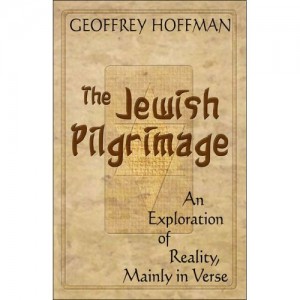 The Jewish Pilgrimage – An Exploration of Reality, Mainly in Verse : The book is clearly written to inspire philosophical discussion. This book depicts the author’s personal journey to find some form of understanding about man, our various versions of God and how this effects society and the use of its knowledge. He debates moral issues and provokes deep thinking in several areas that will never leave my mind as I travel along my own road.
Geoffrey questions the justness of creation itself and the gift of consciousness. Also he cleverly uses metaphors when he depicts various pieces of himself by using the universe, planets and astrological colors. Without a doubt this student of life, takes joy in nature. Throughout the book the author makes his awe in the vastness of the universe quite apparent.
My personal favorite piece was Beautiful Among The Buildings, which used powerful visual statements like:
“Night sprawls among the broken lives that line the broken street;
The lonely and unpitied men whose waste is our defeat.
Men stagger from dank cellars; men, imprisoned in their cars,
Go roaring into sightlessness – unmindful of the stars.”
And the equally powerful anti-war piece, No Frontiers:
” The father carrying the limp body of his child,
The soldier staring at his amputated hand,
The little girl among the bloodied pieces of her parents –
What does it matter if they are of one side or another?
Dogma cannot grieve.
It is the pain of individuals that sears.”
I also really appreciated Half Sight, which discussed the inability to witness the good and love in life when there is so much horror to distract us from it. Today Near Watford Market was a very moving piece for me in that it was so visual. It describes an event where the author witnesses a man speaking to the public about his lack of belief in religion. And “circling like wolves, the true-believers snarled, snapping at both his arguments and him.” Yet nearby an elderly women fell, sprawling her shopping items on the ground around her. The non-believer ran over to her side and helped her on her way, “jostling to her assistance through unmoving ranks of true-believing ice”. It is a beautiful story about seeing God where you least expect it.
In the later part of the book, the author moves away from poetry and gets in to verse debating who the Jewish people are, what they are perceived as being and the persecution of this group of people through the ages. His interesting look at the holocaust does not dwell on the sorrow or loss of the people – rather it centers on the people themselves.
By far, Jewish people are not the only race of people who have suffered at the hands of man and I think the author means to use the example as a tool to accelerate the intellectual growth of mankind. Read More Reviews Here…
